Showing posts with label historical fiction. Show all posts

Friday, October 7, 2016

Rise of the Legend

rise

A new legend begins.

The year is 1868. In the aftermath of the Second Opium War, China continues to sink into chaos as the Qing Dynasty has proven themselves unable to fight Western influence and the influx of drugs and slave labor clinging to the underbelly of capitalism. In the city of Guangzhou, two factions control the Huangpu Port: the Black Tiger gang and the North Sea gang. The two gangs are in a stalemate until a brash young fighter named Wong Fei Hung appears on the scene. In an era where wicked men profit on the misery of the less fortunate, one man will rise up to change history forever. This is the rise of a new era. This is the Rise of the Legend.

kungfu
 
A reckless youth.

Directed by Roy Chow and written by Christine To, Rise of the Legend was released by Edko Films (Hong Kong) in 2014, and picked up by American distributors Well Go USA in 2016. A wuxia in the same vein as Hero and House of Flying Daggers, Rise of the Legend follows the early life of Chinese folk hero Wong Fei Hung. Martial arts fans know that Wong Fei Hung's life has spawned numerous media including television shows, comics, and more than 100 films, most notably Jet Li's "Once Upon a Time In China" series and Jackie Chan's "Drunken Master I & II." When I first heard of Rise of the Legend my immediate reaction was "Omg not another Wong Fei Hung movie." Retreading old ground doesn't do anything for this reviewer so I was put-off from the film at the outset. However, Well Go USA only picks up the finest movies for American distribution. Given that this is the same company who brought us badass films like Wolf Warriors and Police Story: Lockdown, I had a feeling this movie would be something special.

risepeng
 
Eddie Peng delivers his finest performance yet!

Rise of the Legend presents Wong Fei Hung as a cocky, vengeful, and borderline ruthless Wong Fei Hung. Overtime, we see Wong Fei Hung mature and become the hero China needs him to be. Eddie Peng does a superb as leading man and he absolutely owned the scenes. I've seen countless Wong Fei Hung films and Eddie Peng's performance is right up there with Jackie Chan's and Jet Li's. Eddie Peng's performance was gripping, but he wasn't alone in that regard.

bigsam
 
BIG SAM!

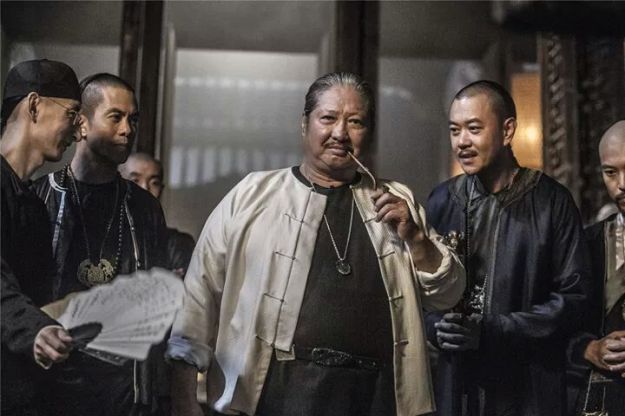
The film has a great cast including Angelababy, Wang Luodan, and the legendary Sammo Hung who plays the villainous Master Lui, leader of the Black Tiger gang. I was pleasantry surprised by Hung's performance who typically plays the good guy, was intimidating and almost scary as Master Lui. Sammo Hung has a commanding presence and brings a completely different atmosphere to each scene.

risingpunch
 
FALCON PUNCH!!!

Industry veteran Corey Yuen is on board as the film's action director and his expertise really shows. Rise of the Legend has some spectacular fight sequences that do a great job of balancing brutality and style. The choreography is very well done and the hits feel like they have impact. While I felt there was a bit too much wire-work at times, I understand that's something of a mainstay of wuxia.

rotl

Must see!

The film has its flaws. It shows us an aggressive, hot-blooded Wong Fei-Hung which I thought was an interesting change of pace from the patient and wise folk hero. However, we're never given a reason for why he is the way he is. Even as a child the Wong Fei-Hung we see is violent and short-tempered, but we're neither shown nor told as to why that it is. It would make sense if it occurred later on after tragedy struck, but it seems he was always a wild child in this film. The film's score - while good wasn't memorable and I felt that a good 20 to 30 minutes of the film should've been cut because it took too long getting to the climax which was a bit rushed. Overall Rise of the Legend is a great martial arts movie and a must own for anyone into historical fiction or action movies.


Wednesday, August 10, 2016

Feng Shen Ji

Emperor Zhou

More epic than Dragon Ball.

Eons ago the gods created the heavens, the earth, and the realm below. Having set the foundation of the world the ancient god Tian created humans in the image of gods. For centuries the Great Shang dynasty has prospered in service of the gods and relations have been amicable, until now. Emperor Zhou has grown tired of the gods treating human beings as their slaves. While he has great wealth and power, he understands that the gods use prosperity only to train humans as though they were dogs. What Emperor Zhou desires is not more wealth or power, but freedom for all people. When a messenger from gods informs the emperor that Tian wishes for him to conquer and enslave the surrounding kingdoms Zhou doesn't hesitate to express his discontent. He announces he will rebel against the gods and liberate mankind. The heavens have declared that there will be dire consequences for this act of rebellion. In the name of the Shang dynasty Emperor Zhou gives his royal decree - "Just Bring It."
Unleashed
 
Putting the fear of Man into the Gods.

Emperor Zhou fires the first shot against the heavens and while the gods mock him and regard him as a monkey, they quickly realize the status quo is about to change as Emperor Zhou turns one god into cold cuts and holds his own in a battle against five others - BY HIMSELF.

Tian2

When Tian descends people die.

He puts so much pressure on the gods that Tian himself has to enter the fray to stop him, bringing Zhou's rebellion to a tragic and bloody halt. This isn't too much of a spoiler, because the story isn't about Zhou. This story is about his son Wu Geng who will later become known as Ah Gou - a legend in his own time.

Savior

Savior

I know the term epic has been essentially ruined by pop culture hipsters, but this is one of the few instances where the term is applicable. Zheng Jian He is a superb writer who clearly set out to make Feng Shen Ji more of a legend rather than a typical comic. This story is so huge that at times it makes Dragon Ball seem small by comparison. The story evolves through numerous plot twists, absolutely mind-blowing battles, and extensive development for its enormous cast of characters. There are all kinds of exotic animals and wildlife, and numerous myths in-universe about martial arts techniques, immortals, and even the origins of the gods themselves. There's even lore surrounding various weapons and locations. This epic tale spans more than 200 chapters and there are some huge plot twists that change the narrative only five chapters in.

Ah Gou Legend

Meet your new favorite character.

As mentioned above this is Wu Geng's story. After a series of extraordinary events which I won't spoil, Wu Geng finds himself trapped in the body of a previously dead slave named Ah Gou. This is the same slave who Wu Geng beat and tried to torture prior to the events of the story. Understand that Wu Geng was a terrible child who didn't inherit any of his father's love towards his fellow man. Once a proud and arrogant prince, Wu Geng now finds himself assuming the identity of Ah Gou - a slave and in his mind the lowest of all people. This is a humbling experience that changes him for the better. Wu Geng understands his old life is gone. He fully accepts his new identity as Ah Gou and learns to love and lead his fellow human beings after having suffered as they have suffered.

MOS

Step back Goku. Watch out Superman. Ah Gou is coming to town.

Feng Shen Ji follows Ah Gou from childhood, to adolescence and into adulthood so he grows a lot over the course of the story. His development is fantastic largely because he's so different from every other heroic character out there. After losing their parents, anyone else would be motivated solely by revenge and rightfully so. However, as a slave Ah Gou's first priority is survival. As he grows closer to those around him, he becomes less focused on his own survival and more focused on ensuring he's able to free his friends from servitude under the gods. Ah Gou isn't stupid. He's smart Maggle. Smart. Ever the opportunist, Ah Gou uses his captivity to make himself stronger, learn more about the gods and why they need humans to excavate bloodstones, and even work his way into the good graces of his owner so he can sabotage the entire operation. He uses his cunning to stay several steps ahead of his enemies and he ensures the survival of not only himself, but his friends.

Get Wild
 
To the window! To the wall!

After escaping captivity he trains with powerful teachers and also in solitude. At first Ah Gou can't even throw a punch, but as time goes on he becomes strong enough to do battle with the gods, even trouncing some of them with ease. While the gods initially scoff at him, they come to recognize him as a terrible threat and the Dark Ones - a race long opposed to both gods and humans acknowledge Ah Gou as their equal.

The One
 
His evolution knows no limits.

Ah Gou is cocky enough to laugh in the face of the gods and he's resourceful enough to tear them from the heavens and take the throne for himself. He's similar to Yusuke Uremeshi, but 100x more badass. Thus he's not your typical, boring shonen character (Naruto, Ichigo, etc.) who always wins all the time in absurd ways. Ah Gou is the embodiment of epic, but he's not a Marty Stu. In a world where literally everyone is a badass and his enemies are the gods themselves, Ah Gou isn't ashamed to ask for help nor is he above using dirty tricks to take down his enemies. Even if said trick involves kidnapping the son of a slave owner to get what he wants. He'll do what he needs to do to get the win and he'll flip-off his enemies while doing it.

A Child Will Lead Them
 
And so a child will lead them.

There are times when he lets his power go to his head and his inexperience at life does get him into trouble from time-to-time. There are also occasions where he becomes too cocky and even comes to blows with his uncle Zi Yu - the godslayer. His flaws make him an endearing character because it's his imperfections that make him feel more human. Despite his shortcomings he becomes a folk hero even as a teenager and he attracts followers of different races and species from all over the realms because of his charisma, power, intellect, frank manner, and rather eccentric personality. I could easily spend the rest of this review talking about Ah Gou, but he's just one of many in a manhua overflowing with fantastic characters.

Dark Generals
 
The Dark Generals

The Dark Ones are an ancient race with centuries of bad blood with the gods. Led by thirteen generals who follow the command of Ni Tian Er Xing (far left) the Dark Ones have been looking for an opportunity to emerge from the shadows and take their revenge on the gods. A combination of Emperor Zhou's rebellion and Ah Gou declaring war on the gods brings them out of hiding and they provide a badass boon to mankind's coup d'etat. But don't think they're all on the same side. What's great about these characters is that not all of them get along just because they're from the same culture. The writing is more natural than that. They all have different personalities, beliefs, and feelings towards other races and each other. Many of the Dark Generals are actually enemies whose only reason for teaming up is the destruction of the gods. For example Si Wang Yen Shen (far right) despises the other generals, Er Xing in particular and makes it known that after the war is over all bets are off. Yen Shen also despises Ah Gou and the two have some tense interactions. In addition to having their own myths, the Dark Ones also have different styles of martial arts not seen anywhere else in Feng Shen Ji thus adding another layer of authenticity to their civilization.

They Descend

They Descend

Don't think of the gods as being specist mind you. While the vast, vast majority of them do regard humans as animals some have different ideas. While none of the gods think humans can ever be equal, some feel that humans should be left to their own devices, others think the humans need to be led, and one god in particular couldn't care less because he just wants to party and hit on hot women. Similar to the Dark Ones and the humans, not all of the gods get along just because of their divine nature. There are differences in their personalities and even status. Also similar to the other cultures we see in this manhua, the gods have their own martial arts never seen in the mortal world and trust me when I tell you that the words "shock and awe" could not be more appropriate. And there are still other races and martial arts the reader encounters in Feng Shen Ji besides the ones I introduced.

Dominance
 
The best battles you'll see anywhere.

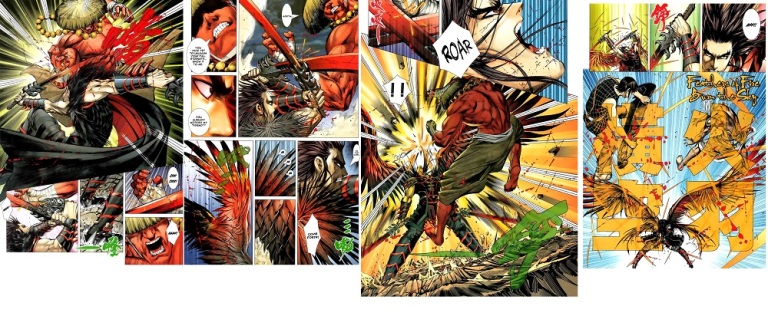
The battles in Feng Shen Ji are simply mesmerizing. Saying they put DBZ to shame would be an understatement as animating even a handful of them would likely bankrupt a studio. There are your classic speed lines, special moves displayed in giant Chinese characters, entire cities being leveled brick-by-brick as these warriors deliver tremendous blows that shake the heavens and the earth. The battles just get bigger and more epic as the manhua goes on and some phenomenal artwork is on display. Cheng Kin Wo and Tang Chi Fai bring their A-game and firmly establish themselves as the best artists in China. Every fight looks and feels like it's going to be a cataclysmic conflict and it almost always is.

DWTL
 
This is going to hurt. A lot.

Some of the fights take their cues from Jojo's Bizarre Adventure where opponents basically try to out-gambit (or out-Joestar) each other. On occasion  an enemy will be on the offensive, only for Ah Gou to say "AHA! I knew you'd do that so here is my real plan". To which an enemy will respond, "AHA! I knew that this was your real plan all along and I'm two steps ahead." Only for Ah Gou to finish with "AHA! I've been five steps ahead this entire time." It's awesome in this somewhat absurd, meta-way and it makes for some entertaining fights and reactions from the characters therein.

What
 
Siri did it to me again.

The world of Feng Shen Ji is massive and there are numerous moments where the characters themselves are just as amazed as the reader at what they discover. There are legends older than the gods themselves, civilizations even the Dark Ones regarded as mere fairy tales, and the reader bears witness to first contact between cultures. There's more going on in this world than even the characters themselves know about and you learn as they learn.


Zi Yu
 
Uncle BADASS

The central themes of Feng Shen Ji are freedom, responsibility, and family. Regardless of where they're from the majority of the characters want the freedom to live their lives in the way they think will best suit them. Most of the cast has tremendous physical, spiritual, and even political power, but very few use it for the right reasons. The majority of the problems in this manhua stem from an authority figure abusing their power and it's not always the gods. The cast has to learn that if they don't wield their power responsibly they stand a very real chance of worsening the same problems they're trying to solve.

Brother Gou
 
Family

Family also plays a role in Feng Shen Ji. Ah Gou forges a strong bond with his uncle Zi Yu who he sees as a teacher and father-figure. After proving his strength, the Dark Ones come to see Ah Gou as their brother and he is welcomed as one of their own by "most" of them. Ah Gou (and hopefully the reader) learns that blood isn't the only thing that makes a family, but also who you love, honor, and protect.


FinalBattle

Ah Gou vs Tian: He will avenge his father or die in the attempt.

As you've probably surmised Feng Shen Ji is a truly epic tale. Any reader interested in this title should take note that it does require a substantial investment of your time. Recall that the story follows Ah Gou from childhood to adulthood and so you won't see any titanic battles for quite awhile. After the introductory chapters, the majority of the first part is Ah Gou developing as a human being not just a fighter. However, once he comes of age and begins to strut his stuff get ready to see some truly awe-inspiring conflicts. With fantastic artwork, superb writing, several plot twists, a great cast of characters and mythic story-telling that makes this world seem alive, Feng Shen Ji is a gripping tale from start to finish. I highly recommend this comic for anyone and everyone interested in a modern myth they won't ever forget.

Thursday, September 17, 2015

Goemon (2009)

An unforgettable film.

Goemon is a 2009 Japanese historical fiction film written and directed by Casshern's Kazuaki Kiriya. The film follows Ishikawa Goemon, a Robin Hood-esque figure and his exploits during the end of the Sengoku period. The star-studded cast includes Yosuke Eguchi as the titular Ishikawa Goemon, Aragami and Sky High's Takao Osawa as Kirigakure Saizo, and Ryoko Hirosue as Goemon's love interest Chacha. Film legend Eiji Okuda plays the main villain Hideyoshi Toyotomi, and Kamen Rider Agito's Jun Kaname plays the scheming Ishida Mitsunari.


Oozing with stars!

When the film opens, we find our hero Goemon breaking into the royal vault where he helps himself to Hideyoshi's gold and other treasures. As guards storm the room, Goemon makes a daring escape across the rooftops, charming the people and showering them with gold along the way when he reveals a blue box which appears to be entirely ordinary. It's not gold so he simply throws it away. Unbeknownst to Goemon the box he discarded contains a map which points the way to a hidden scroll that contains highly classified information regarding Toyotomi's rise to power and the conspiracy surrounding the Honnoji Temple incident. Because Goemon is the last person who was in possession of the box, a number of powerful figures want his head including the current daimyo Hideyoshi Toyotomi. Other power-players include Toyotomi's rival Ieyasu Tokugawa, and Toyotomi's traitorous minister of finance Mitsunari Ishida - both of whom send shinobi after Goemon including Goemon's best friend Saizo and Goemon's master the legendary ninja killer Hanzo Hattori. The situation becomes even more complicated when Chacha, Goemon's childhood friend and Toyotomi's concubine gets caught in the middle. What transpires is a long, action-adventure thrill-ride filled with drama, moral dilemmas, and stunning fight sequences.


Saizo vs Goemon

As mentioned above, the film was written and directed by Casshern's Kazuaki Kiriya. He's refined his craft since 2004 and many of the earmarks of Casshern are present here such as a cast of rich characters, an inversion of tropes, and a different take not on the perception of good and evil, but which characters we are prone to seeing in that manner. "Goemon" uses its two hour run-time very effectively which is a must for a film juggling so many plot points. As a work of historical fiction, the film gives a different take on the final events of the Sengoku period i.e. the Battle of Sekigahara, the establishment of the Tokugawa Shogunate, and the Siege of Osaka. At the same-time it explores the relationships between all the main characters and develops their personalities through major events in the film, playing with the viewer's expectations along the way. For example, in most films of this nature the dichotomy between Goemon and his rival Saizo would be one of good versus evil. However, Saizo is a man who fights for his family while Goemon (at least initially) is a man who fights only for himself. It really changes how we see our characters when Saizo forces our protagonist to reevaluate his life choices and how they affect the people around him.


Oda Nobunaga

The film has a generous amount of character development for nearly everyone not just our lead Goemon. We see what motivates these characters, what drives them to be forces of good or evil, and the toll it takes on them. Hideyoshi Toyotomi was a peasant, but worked to get to the top. His efforts were noticed by Oda Nobunaga who took him under his wing. Whenever Toyotomi couldn't achieve his objective through hard work, murder became a more viable alternative. The poverty he endured manifested as greed and that insatiable appetite for more, or perhaps the fear of having to live without the necessities for survival drove him down a path of evil. What I especially enjoyed was "Goemon's" characterization of Oda Nobunaga. Hashinosuké Nakamura plays Oda Nobunaga, the most famous (or infamous depending on your perception) warlord in Japanese history. However, the film doesn't portray Nobunaga as a ruthless warlord like most other fiction are prone to do, rather we see Nobunaga as a man doing what he feels is best for the future of his people. He doesn't always make the best decisions, but every move he makes is motivated by the need to build a happy future for all. I was really captivated by this approach and Nakamura's performance. Doubly so because Nobunaga made a profound impact on Goemon which the film explores.


Taking a level in BADASS.

The world is gorgeous, wonderfully imaginative and the costume designs are superb, mixing eastern and western styles which adds to the film's swashbuckling feel. Goemon's default attire even has similarities to 1922's "Robin Hood". The film has a powerful orchestrated score which adds weight to every scene. While I'm not normally a fan of a lot of CG, I don't mind it so much here because similar to "Casshern", given the style of world in which this story takes place and the fight scenes it couldn't be filmed in any other way. The fight scenes themselves are a sight to behold with the second to the last battle defining the word epic. We see Goemon dodging bullets from several Gatling canons (yes canons and yes several), wall running, leaping over castles, and fighting hundreds of soldiers. Imagine the opening to Onimusha 3 or Onimusha: Dawn of Dreams but 10x more awesome.


"The sky is crying."

Sure the film isn't perfect. While anyone can enjoy it, it may be difficult for some viewers who aren't familiar with Japanese history or at least the Sengoku Period as there are a lot of historical figures in the movie. While the movie juggles a lot of plots, subplots, and relationships very competently, it may be hard to keep track of for some viewers. As you can see from the trailer there is a lot of CG in this film and if that's not your thing the film may be a turnoff. Those items aside I found "Goemon" to be a very enjoyable film and it really sold me on Kiriya's style of writing and directing.

Sunday, June 1, 2014

Otoyomegatari (2008 - Ongoing)

Amira and Karluk

Written by famed mangaka Mori Kaoru, and published by Enterbrain in Japan and Yen Press in the United States, Otoyomegatari (A Bride's Tale) is a historical fiction/slice of life manga. Taking place during the late 19th Century and set in Turkic Central Asia, it follows the story of a young woman named Amira Hergal who is married off to a suitor named Karluk Ayhan as is the custom. Much to Amira's surprise however, her suitor is eight years younger than her. This unique irony is not lost on her or any of the other characters for that matter, but the two try to make the best of it. All is well until Amira's family shows up some months later and seek to end the arrangement with Karluk's family and marry Amira off to another tribal head who while possessing sizable land and military power, was also responsible for the deaths of his two previous wives who were also Amira's older sisters. When Amira's complete shock and utter terror isn't enough to deter her father's wishes, the breach in cultural norms turns into a full-blown tribal war.


Y'know how it is when your husband is a kid.

This might seem like something of a spoiler for a major plot point and while this conundrum becomes a focal point of the story there are events before and after the tribal war which not only focus on Amira and Karluk but other characters as well. Kaoru shows off her writing chops in building the main story and developing peripheral characters in addition to telling their stories as well.


Amira at home.

What is amazing about Kaoru's writing is that she is able to capture the beauty and significance in what might seem like the most mundane aspects of life but nothing here is trivial. She clearly did a great deal of research into the living habits and culture of 19th Century Turkish people and that comes across in nearly every panel in each chapter and is further accentuated by the characters personalities and habits across various tales. 


"All the power in the world resides in the eyes."

This is a "slice of life" manga which means that a lot of the narrative revolves around everyday things from family gatherings, to trips to the city, and hunting. This is important to note because these details also play a role in character development. We learn early on that Amira comes from a tribe of nomads and given their lifestyle hunting plays a major role in their survival. Even among her clansmen Amira is considered one of the best; excelling in tracking, archery, and horsemanship. On the other hand Karluk's tribe are pastoral in nature whose hunting techniques have been lost for at least three generations. There is a believable sense of amazement here not because Amira is a woman but because she not only knows "the old ways" but she excels at them. 


Amira is the best at what she does.

Amira is a great female lead in part because Kaoru never makes a big deal about how strong she is and how independent she is and omg look you guys she is so cool. In essence, Amira's role as a powerful female lead is a natural exploration of a nomadic woman from this time. In addition to being skilled at hunting, tracking, and horseback riding, she also knows her way around a fight and even her older brother who is an exceptional warrior acknowledges her. She isn't a superhero or the stalwart icon of anyone's particular agenda but a human character serving as a natural representation of the lifestyle and the times. At her core she's a badass normal character with personality and that is what makes her so appealing.


There will be blood.

All of the women in the manga are outspoken which in addition to being historically accurate also breaks down the western stereotype that outspoken women is somehow new. This is clearly seen in a thought-provoking and humorous exchange between the men and women of Karluk's clan when they argue about how Karluk and Amira should act towards each other, with neither of them being able to say anything. Karluk on account of not quite being a man and therefore having no say while Amira still being new to the family and not knowing quite what to say. While I'm tempted to go on about Amira for another three paragraphs (because she is cool she is badass and omg look you guys one of my favorite characters) she's not the only character explored in this title.


Prepare for trouble. Make that double.
This slice of life title doesn't just take slices out of Karluk's and Amira's life but the lives of several other characters as well. One of the side-stories involve two girls trying to find wealthy husbands so as to ease the financial strain on their family. What's funny is that the twins take off their head-coverings when they spot a man they want (because only a husband is allowed to see their wife's uncovered head) and try to use that as a ploy to force him into marriage. This never works and a fair share of the men they run into seem to pick up on the game right away. This doesn't stop them from trying it however. 


Beautiful but frail.

Another side story revolves around a young woman named Talas who is living with her mother-in-law without her husband. This detail is very telling of her compassionate nature because in this culture it is unusual for a woman to not return home after her husband has died. However, Talas's mother-in-law is very old and frail and Talas refuses to leave her on account of wanting to take care of her. This is reminiscent of Naomi and Ruth from The Bible. Some further intrigue comes into play when Henry Smith (a close friend of Karluk's family) runs into the mother and daughter on one of his trips and stays with them for awhile. Henry and Talas soon fall in love with each other much to the approval of Talas's mother-in-law who wants Talas to move on and find happiness.


Azel The Fang

Amira's older brother Azel also gets some character development as well. When the tribes are on the brink of war Azel gets a lot more panel time and we quickly learn he's a calculated and resourceful sort. While he's as fierce as the wolves his tribe is most often associated with, we also learn that in his innermost depths is a great deal of loyalty and devotion to duty. It's a character trait that is tested by fire when he must choose between his sister and his tribe. What's great about character development like Azel's is that it is reflective of the overall approach to this title and that's the emphasis on character interaction.


Azel is not impressed.

Otoyomegatari doesn't just go from one event to another but it focuses on how characters interact and associate with one another. One example includes Azel's interactions with his cousins when talking about the upcoming war and a lot is learned about Azel and his cousins based on how they discuss dealing with this problem. I also like the interaction between Henry Smith and Karluk's family. Henry has been staying with the family for months and apart from calling him Mr. Smith he is seen as a very close friend - if not another member of the family despite the fact that he's a westerner. We're not "told" the family gets along with him rather we see how the characters interact with one another at meal time and discussing everyday activities. One of the scenes I found most telling is when the patriarch is planning to purchase some things from the city and everyone including Mr. Smith starts making request with the only protest being the patriarch is buying everyone what they need and not what they want. Never is Mr. Smith excluded because he is a foreigner which is very telling of the inclusive nature of many tribes.


Just the tip of the iceberg where detail is concerned.

Kaoru isn't just a brilliant writer she's also an amazing artist as these panels have no doubt shown already. The amount of detail she puts into drawing characters eyes and even the position of their fingers in certain acitivities carries over into how she draws the environments and objects like cookware, weapons, rugs, and clothing. This manga is clearly drawn by someone who has both respect and admiration for the culture she is writing about which is outside the norm for most mangaka.


It's going down.

In addition to being a slice of life manga Otoyomegatari is also seinen. That means it has mature content but to a lesser degree than other seinen titles. There is violence but no gore to speak of and barely any blood. There is nudity but it's rare and where it is present it is done tastefully - typically when a character is bathing which makes the most sense. The mature content of the title largely comes in the form of these being characters with real problems. No one is trying to save the world or become hokage but characters are trying to live in politically and culturally turbulent times. Some aim to embrace the new ways while others prefer to stick to the old.


Thinking of home keeps Amira up at night.

With all this in mind Otoyomegatari is a fantastic read for someone looking for something different. It has great characters, a lot of touching moments, and even some humor and tragedy as well. And when the fighting does start Kaoru isn't afraid to let tensions run high, but she also has the integrity to know when to end a subplot and progress story. It's not for the culturally insensitive however as some of the practices explored here (marrying women off for x-reasons) are foreign to us but natural to the culture the manga is focused on. If you're willing to step out of your comfort zone you'll find a great story here that doesn't disappoint.